Where Did My Resume Go...? - A Review of the "Chance Gathering" Resume Study Group
Let’s take stock of my three and a half “forgotten” (not “lost”) years! Here’s a look at the ins and outs of the “Chance Encounter” resume study group with people from other fields!
내 이력은 어디로 갔는가.. - '어쩌다 모인' 이력서 스터디 후기 | Lizzie's Blog
Introduction🙋♀️
It’s been over three and a half years since I started my career as a backend developer. Around this point—or perhaps even earlier—developers usually start thinking about organizing their resumes. Of course, I was no exception.
Actually, when I was still a complete junior, I used to update my resume little by little. But at some point, I stopped keeping it organized. I think the last time I updated it was during my first year on the job. Although my mindset—'이력서 정리 한 번 해야 하는데...'—remained the same, I couldn’t bring myself to start easily, partly because I used “being busy” as an excuse and partly because of the resistance I felt toward the task. However, as time went on, my determination to get it organized grew stronger and stronger. 💪
In this post, I’d like to share the story behind how I started a resume study group, how the group was run, and the results and reflections from the experience.
The A-Z of the Study Group 📜
Forming the Resume Study Group 🤜🤛
Trying to organize my resume on my own just didn’t feel like it was going as planned, but as it turned out, there were friends who were thinking along the same lines. So, I blurted out **“Hey! Want to join a study group?”**and started recruiting members. (The only thing connecting us was “the author,” but I figured we’d manage somehow.) So, naturally (?), I took on the role of study group leader, and a total of three people joined this study group.
If there was one unusual thing, it was that our roles were all different. We ended up running the study group with a somewhat unusual combination: 백엔드 개발자, 프론트엔드 개발자, and 인사 담당자...! Because of this, we had to think carefully about the study group’s direction and how we’d proceed. 🤔
How Did We Proceed? 📌
Setting Study Goals
Since we all had different roles, I thought it was important to set a clear direction for the study group, so I established the goals first. The group-wide goals were as follows:
💡 Let’s write resumes that provide the minimum necessary information
Of course, this was the minimum goal we set to keep this study group on track, and we also shared our individual goals, believing that having personal goals would allow us to provide more tailored feedback.
Study Group Process
We organized and shared details about the kickoff and the progress of both online and offline study sessions on Notion.
We used Google Docs to conduct the study asynchronously.
The advantage is that it allows for online sharing and real-time commenting
Anyone with a Google account can use it, so there’s no need to switch to Figma or Notion
The focus was on organizing content -> We agreed to recommend other platforms later if design considerations arise
Many people agreed that organizing and submitting content as Google Docs files is the cleanest approach, etc.
We established ground rules. We defined just three key points.
Each person must provide at least one piece of feedback to others every week
Each person must version control their own resume
Recognize the differences in each other’s job roles and proceed with the study group accordingly
Typically, we shared resume feedback asynchronously via Google Docs comments, and discussed topics we wanted to explore in more depth during our regular meetings.
Regular meetings were held once a week and lasted about an hour and a half
Collection of Key Feedback on Resumes 📢
Is a longer resume better or worse?
Resume vs. (Portfolio or Career Summary)
Considering the role of a resume, **the key is ultimately to make it easy to grasp at a glance
**; therefore, the final conclusion was to avoid including too much content.
Organize any additional or detailed information derived from the resume content into 포트폴리오 or 경력기술서
Organize your text in bullet points
Avoid formal written language as much as possible. Since it sometimes creeps in, ask GPT to polish it.
Include the duration for each job experience
This allows the reader to gauge how long you were employed at each position
Write the reason for leaving at the bottom of each job entry
Knowing the reason for moving between jobs can help the recruiter better understand your career path
In the “About Me” section, highlight your strengths and provide concrete examples of your actions to support them
What’s the final result?🌟
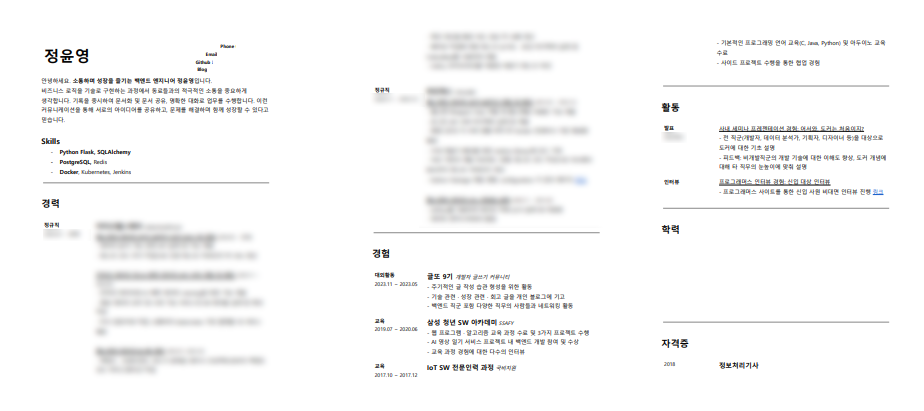
In my case, I organized the content into a total of 3 pages divided into 간단한 자기소개/연락처/주 스킬/경력/경험/활동/학력/자격증 sections. I’ve attached a photo of the final result!
(Since personal information has been redacted, the results of this study are shared for reference only)
The other study group members also completed the resumes they had set out to create. Of course, this was just about establishing a baseline for self-assessment, and we agreed to seek additional feedback from our respective seniors and colleagues.
What was it like participating in the study group?😶
From the Perspective of Achieving the Goal
Starting with this study session, I’ve been able to organize my career history from a macro perspective. Since I achieved my intended goal, I felt it was definitely worth participating in this study session.
Of course, there are still areas that need refinement. The most important one is connecting my personal introduction to the summary of my career experience into a single 컨셉 and ensuring that the narrative flows smoothly.(This was something I hadn’t really thought about during the study group, but I realized it later while writing my self-introduction.) Also, since my resume will continue to evolve, I felt it’s necessary to update it regularly.
From the Perspective of Running the Study Group
It’s been a really long time since I’ve run a 스터디 진행, so I’m jotting down some of the things I pondered. I believe the most important thing is to clearly define the study group’s purpose and effectively guide the members toward achieving that goal. Ultimately, running a study group requires judgment and decision-making within the management domain.
Of course, depending on the nature of the study group, related skills may sometimes be more important. (For example, an algorithm study group benefits from having at least one person who’s good at algorithms.) Still, since the resume study group required sharing diverse perspectives rather than the “ability to write well” itself, I found it relatively easy to manage.
From the Perspective of Running the Study Group
Even though each member had a different job role, there was no sense of dissonance in running the resume study group. I think this was possible because we focused our goal on “just getting it done.” It was achievable by approaching it from a structural perspective rather than focusing on the content itself. Also, I think it was beneficial that our different job roles allowed us to gain fresh perspectives.
In Closing🤗
🔸 I think “taking action” on anything depends on a person’s disposition and willpower. If you feel a task is difficult to tackle alone, quickly find someone to join you. It creates much greater synergy.
🔸 Since many people have already run resume study groups on Geul-tto, I read a lot of related blog posts—which were especially helpful in deciding how to structure this study group.
🔸 As mentioned earlier, I’ve organized the records from this study group on Notion, and I’d like to share them with the consent of the participants. Click here for more details🖱️